MENU
 Produce 'Green Hydrogen' from Water or Ammonia at Room Temperature & Electrochemical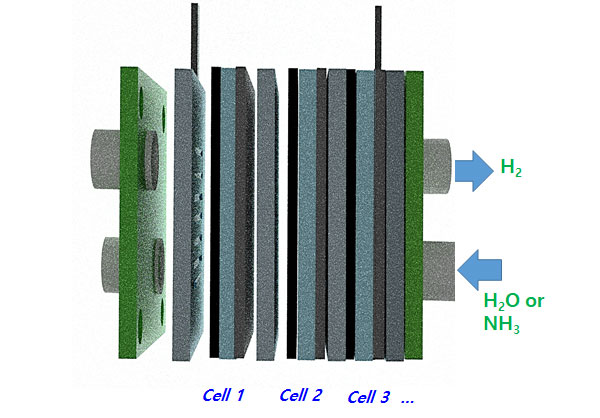
 EcoCatal Co., Ltd. produces green hydrogen (oxygen) from electric stack cells and water
EcoCatal Co., Ltd. produces green hydrogen (nitrogen) from electric stack cell and ammonia
EcoCatal Co., Ltd. produces green hydrogen (oxygen) from electric stack cells and water
EcoCatal Co., Ltd. produces green hydrogen (nitrogen) from electric stack cell and ammonia
| Sortation | Intellectual property rights | |
|---|---|---|
| Korea/PCT | Patent (Application) |
Electrochemical Stack System (Green Hydrogen Production) |
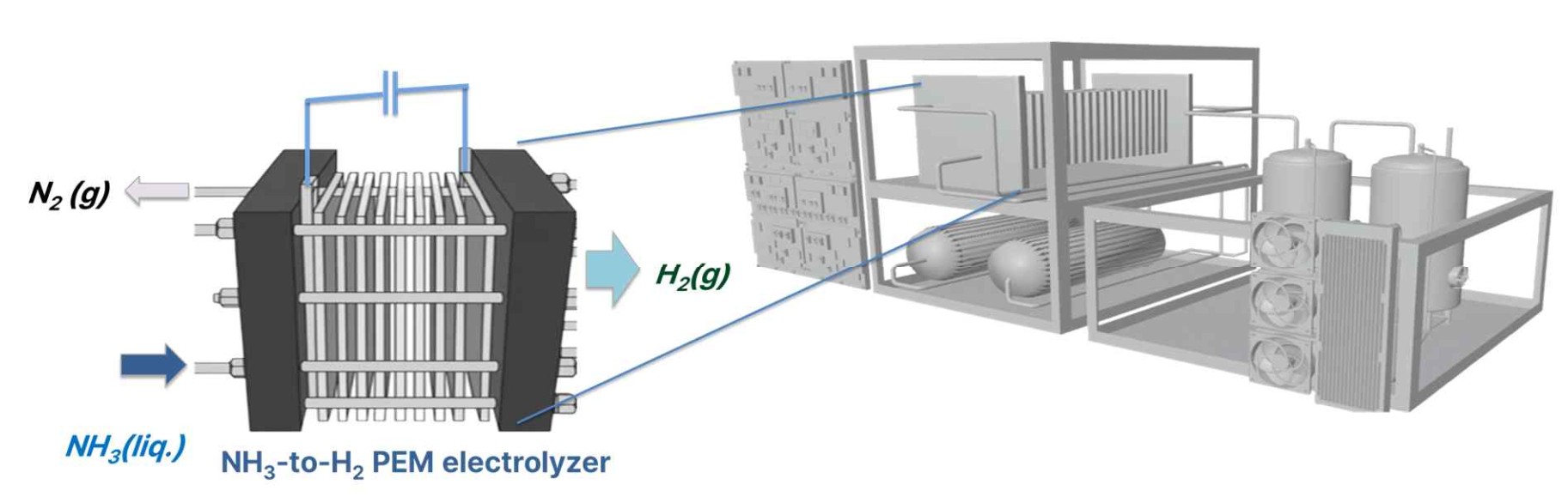
According to coverage by E Today, EcoCatal has introduced an ammonia-based electrochemical PEM stack cell system for producing high-purity green hydrogen. The reported technology focuses on extracting hydrogen from ammonia at room temperature, offering a practical alternative to conventional hydrogen supply chains and supporting on-site hydrogen production.
The article presents EcoCatal’s technology as a new approach to hydrogen handling and utilization, especially in the context of distributed energy systems where compact, modular, and lower-temperature hydrogen generation may offer meaningful infrastructure advantages.
To realize a practical hydrogen economy, it is essential to establish a stable supply chain for hydrogen production, storage, and transportation. Today, countries such as Australia and Canada are actively converting green hydrogen into ammonia for long-distance transport, since ammonia is easier to store and handle using existing infrastructure.
In this context, ammonia is widely regarded as a highly effective hydrogen carrier. EcoCatal’s reported system is designed to extract hydrogen from ammonia electrochemically at the exact place and time it is needed, potentially reducing reliance on conventional high-pressure hydrogen logistics and improving the flexibility of hydrogen deployment.
According to the article, EcoCatal’s system uses an electrochemical Proton Exchange Membrane (PEM) stack cell to recover hydrogen from ammonia. Unlike conventional ammonia cracking technologies that often depend on high-temperature thermal decomposition, this system is described as operating at room temperature.
This distinction is significant because room-temperature electrochemical operation may reduce thermal burden, simplify system design, and make the technology more attractive for distributed and modular hydrogen production environments. The reported system also emphasizes selective hydrogen-ion transport through the membrane, enabling cleaner hydrogen recovery.
The report highlights that only hydrogen ions are allowed to selectively pass through the PEM, supporting the collection of high-purity hydrogen from ammonia-derived electrochemical processes.
One of the article’s most important points is that catalyst and electrode corrosion issues, which have long been considered a major barrier in PEM-based ammonia systems, were fundamentally addressed by EcoCatal.
The technology is described as being compatible with commercially available PEM separators, which improves the possibility of scale-up and helps distinguish the system from Anion Exchange Membrane (AEM)-based approaches.
The article also describes the system as compact and low-power, suggesting its suitability for distributed energy systems, decentralized hydrogen generation, and future RE100-related applications.
In practical terms, on-site conversion of ammonia into hydrogen may reduce the need for dedicated high-pressure hydrogen transport and storage systems. This gives the technology relevance not only from an engineering perspective, but also from an infrastructure, cost, and commercialization standpoint.
Because ammonia is already widely used in industry, the ability to generate hydrogen directly from ammonia where needed may support broader expansion of hydrogen infrastructure without requiring the same level of new logistics investment typically associated with compressed hydrogen systems.
The article states that the Korea Gas Corporation (KOGAS) was scheduled to complete a technical demonstration of the system. Following that demonstration, EcoCatal was reported to be pursuing future optimization, investment opportunities, and cooperation with domestic and international partners.
This helps position the technology not merely as a laboratory concept, but as a platform moving toward external validation, pilot-scale demonstration, and future commercialization. It also strengthens the broader narrative of EcoCatal as a company developing practical next-generation hydrogen infrastructure solutions.